Solar-Powered LoRa Air Quality Monitor
An end-to-end, low-power IoT environmental sensor node featuring custom mixed-signal hardware, I2C sensor integration, and LoRa telemetry.
Continuous environmental monitoring requires hardware that can operate autonomously for extended periods without maintenance. To address this, I engineered a solar-powered, low-power air quality sensor node capable of aggregating diverse atmospheric data and transmitting it over a point-to-point (P2P) LoRa network.
I managed the complete lifecycle of this device, including the mixed-signal schematic design, PCB layout, C/C++ firmware development, and custom mechanical enclosure design.
1. Hardware architecture & Sensor payload
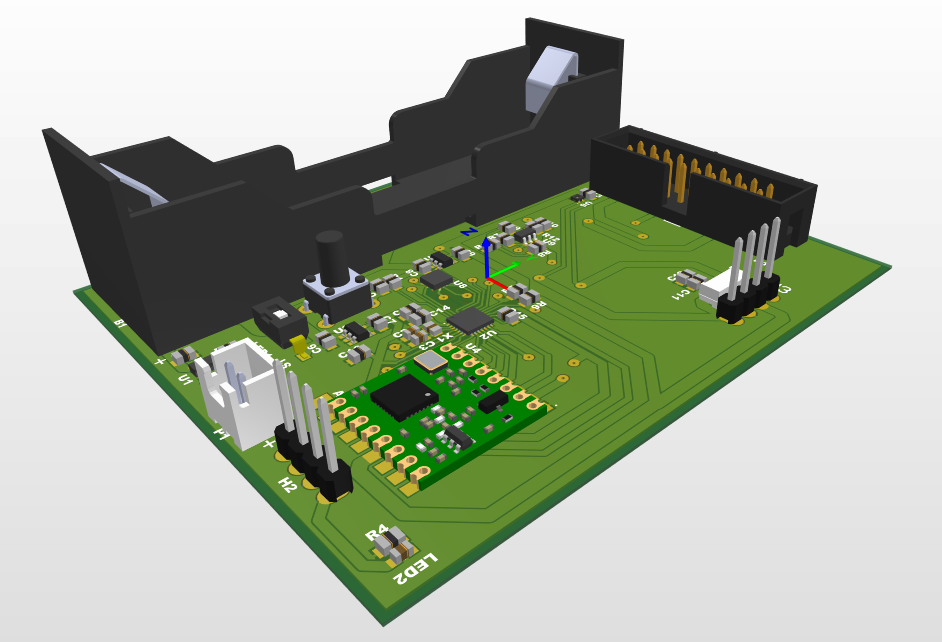
The hardware was architected around a central STM32 microcontroller to balance processing capability with extreme power efficiency.
- Environmental Sensor Suite: Integrated a comprehensive I2C sensor payload, including an Ambient Light Sensor (ALS), a high-precision Temperature & Relative Humidity sensor, and a dedicated VOC/CO2 sensor for robust air quality analysis.
- LoRa Telemetry: Implemented a sub-GHz LoRa transceiver for P2P communications, ensuring reliable, long-range data transmission from remote monitoring sites.
- Low-Power Clocking: Integrated an external Low-Speed Oscillator (LSE) to maintain accurate timekeeping while the primary MCU cores enter deep-sleep states between measurement intervals.
- Hardware Debugging: Incorporated a physical hardware reset (RST) button and dedicated JTAG/SWD headers for seamless firmware flashing and in-circuit debugging via an ST-Link.
2. Power management & Analogue signal conditioning
For a solar-powered IoT device, maximizing battery life and telemetry accuracy is critical. The system is powered by a rechargeable 18650 Li-Ion battery, maintained by a custom solar charge controller circuit and isolated by a physical DIP switch.
Dual voltage regulators (3.0V and 3.3V) were implemented to isolate the sensitive analogue/RF domains from the digital sensor rails. Furthermore, I designed a custom analogue signal conditioning circuit to maximize the resolution of the battery health telemetry.
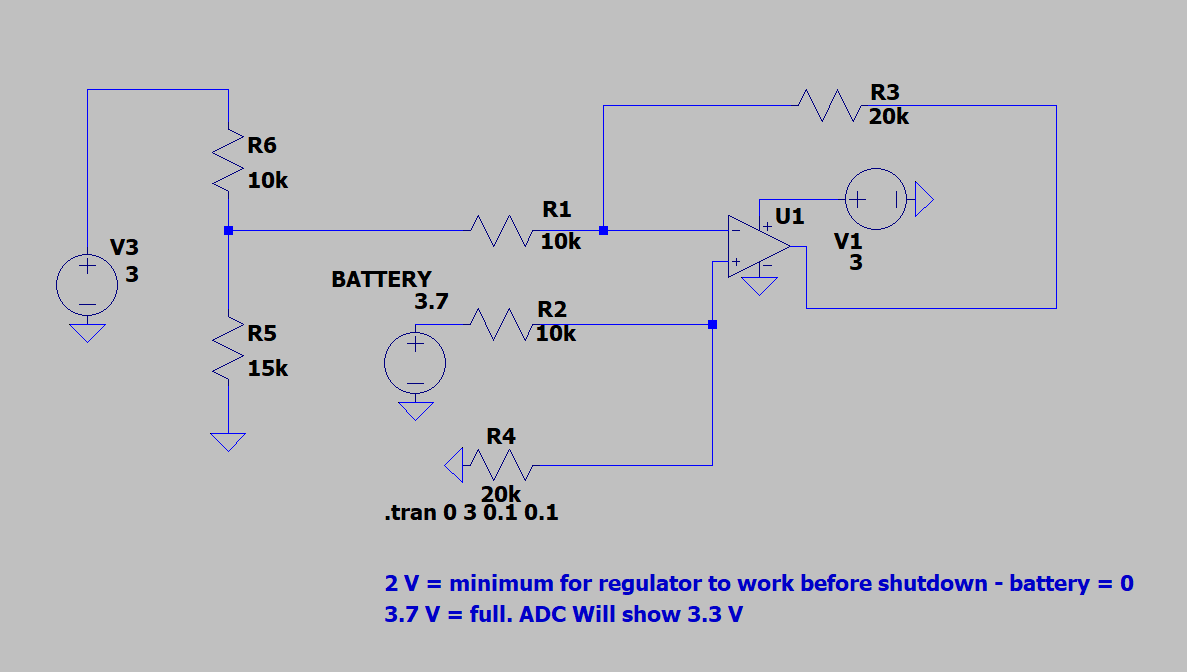
- The ADC Resolution Challenge: The system’s voltage regulators shut down at 2.0V, while the battery peaks at 3.7V. If a simple voltage divider stepped the 3.7V down to the microcontroller’s 3.3V ADC limit, the “empty” 2.0V state would read as roughly 1.78V, wasting more than half of the ADC’s dynamic range.
- Analogue Level-Shifting: I designed a differential amplifier circuit (verified in LTspice) that mathematically applies a DC offset and gain. This maps the critical 2.0V – 3.7V battery discharge curve perfectly onto the 0V – 3.3V ADC input, allowing the firmware to track the state-of-charge with absolute maximum digital resolution.
3. Mechanical enclosure design
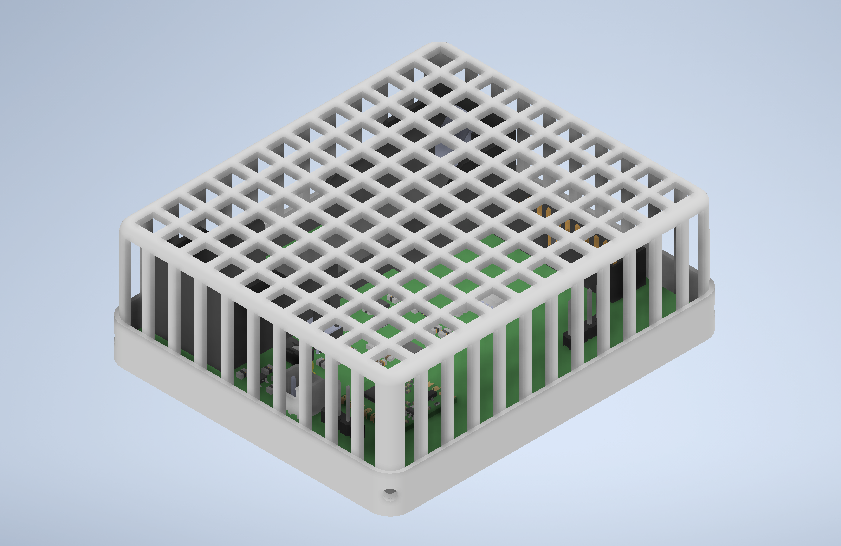
To protect the hardware in deployed environments while ensuring adequate airflow for the VOC/CO2 and temperature sensors, I designed a custom mechanical enclosure.
Utilising Autodesk Inventor, I modeled a two-part assembly consisting of a mounting base and a fitted lid. The design accounted for PCB standoffs, solar panel cable routing, and external antenna mounting, ensuring the final product was both structurally robust and highly functional for atmospheric sampling.
Downloadable documentation: